Our "virtual meeting" last week went so well, we're going to continue the practice next week. This Tuesday (start logging in at 11:45), fellow Rotarian John Juras will be our presenter, covering three topics: First, we all know the importance of staying physically active and healthy while "sheltered in place," but how can we stay active? Second, John will share parts of his ideas about bicycle overnights, a presentation that he is giving to a nationwide audience this Wednesday evening. Finally, John will update us on parts of the River's Edge Trail history and future. Join us on Zoom at this link:
Topic: Sheila Rice's Zoom Meeting
Time: April 7, 2020 11:45 AM Mountain Time (US and Canada)
Your Rotary board of directors will be meeting Tuesday evening via Skype. Rebecca Bogden-Richards is also planning a virtual social for Thursday, April 16, at 5 p.m. More details next week.
Last Week in Rotary
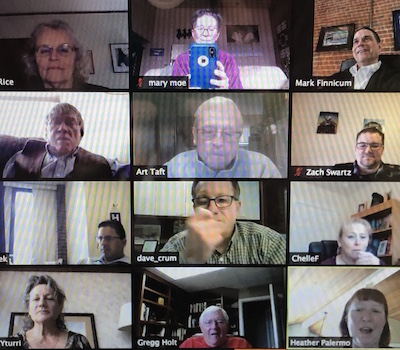
Necessity is the mother of invention! After having to cancel in-person meetings in light of the COVID-19 pandemic, Rotarians decided to e-meet. Thanks to Sheila Rice's familiarity with Zoom, she was able to host a meeting last Tuesday that at its peak had more than 20 attendees.
Our presenter was fellow Rotarian Dave Crum, who apprised of the challenges that the Great Falls Public Schools Foundation is facing in the current crisis. Some time ago, the Foundation began dedicating some of its funding to the food crisis in our schools. Why? "Children can't learn well when they aren't well-fed," Dave told us. Although federal programs provide breakfast and lunch in low-poverty schools, there is still a need to help students through the evening and through the weekends.
Our public schools are still providing free breakfasts and lunches and, thanks to the generosity of the community, the food pantries in all our schools are well-stocked at present. The Foundation does not provide staffing for the pantries. Those volunteers come either from PTAs or from teachers who want to help.
The main challenge the Foundation is facing is scheduling its scholarship awards ceremonies and its awards for teachers, as well as its innovation grants. These events are always powerful in terms of the message they send to students and to teachers. Donors also like to see their philanthropy play out in the stories of appreciative students and staff. With no way of predicting when, if at all, school will reconvene, these important events are on hold. Dave is exploring innovative ways to produce the same outcomes.
Although meeting virtually is definitely not the same as meeting face-to-face, attendees expressed delight in seeing one another, if only on a computer screen. The humor, concern, and desire to serve that characterize all our meeting were much in evidence as well. We hope to have another meeting next week and if you have a presentation you'd like to make, contact President Yturri.
In unrelated - but important! - news last week, the Global Polio Eradication Initiative (GPEI) recommended suspending polio vaccination campaigns to help stop the spread of the novel coronavirus. It was a decision described as painful, but "We have no choice," GPEI's executive director said.
Spotlight on ... Kurt Baltrusch
When Kurt Baltrusch was promoted to Assistant Manager of the Billings Division of Montana Dakota Utilities Co. 35 years ago, he decided it would be a good idea to join Rotary. It certainly was a good thing for Rotary Club of Great Falls. There is no task too big or too small for Kurt to do for the club.
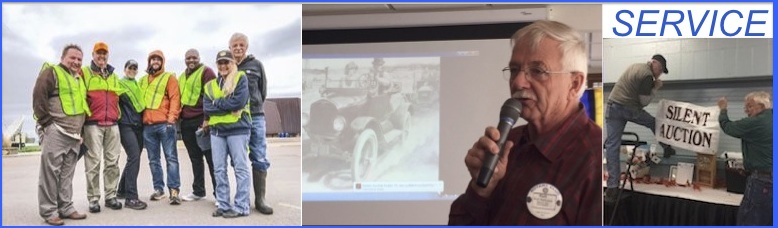
Line up speakers every week? Sure. Serve on the board? OK. Volunteers needed for a highway cleanup or Camp Rotary clean-up or a special project? Kurt's hand always goes up. He spent an afternoon a week for months in the History Museum getting ready for our centennial celebration. Although a "noon" Rotarian he regularly attends evening meetings. Kurt epitomizes not only service above self, but also extraordinary service to the club.
"He's smart, kind, caring, and giving of his time," fellow Rotarian Art Taft said. Like a number of stellar Rotarians, Kurt posed a challenge for his teachers when he was young. "I was the original ADHD kid and while teachers and others handled that inappropriately by today’s standards, I was able to channel that productively throughout my career. I could multi-task and get lots done. I depended immensely on good employees and knew who could help when I needed it."
Kurt joined Rotary in 1985, shortly before women were allowed to be members. "The Four-Way Test has existed in Rotary since the 1940s," he mused. "The fact that it took a Supreme Court decision to allow women into Rotary boggles my mind and reminds me how much the country has changed in my lifetime." Opening Rotary's doors to women was a great change, in his view. "We've made such great strides since then. We need to continue showing the positive side of what we have done, while still solving the negatives, and try to be open to further changes."
Why join Rotary? Kurt's answer is simple - and compelling. "Where else can you join a group that does so much for so many? " If you know Kurt, you can only think of one thing to add: Yes - and meet such amazing people!
In the Beginning ... the Polio Crusade
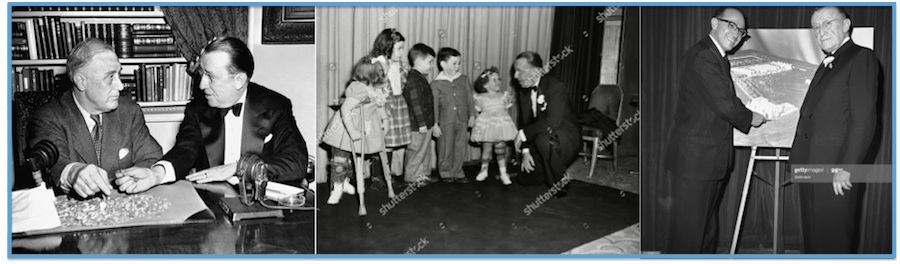
Before Polio Plus, before Sabin, before Salk, there was Basil O'Connor. The scrappy son of an Irish immigrant in Massachusetts, he began selling newspapers at age 10, quickly organizing a monopoly of the best routes. He played fiddle in a local dance band to earn money for college. After graduating from law school, he struck up a friendship and then a law partnership with Franklin Delano Roosevelt. The rest is history.
Roosevelt asked O'Connor to head up his Georgia Warm Springs Foundation, dedicated to providing therapy for polio victims. That foundation morphed into the National Foundation for Infantile Paralysis during the FDR presidency, and O'Connor remained at the helm. Philanthropy was hard to attract during the Depression, but O'Connor came up with the wildly successful idea of a March of Dimes, revolutionizing fundraising in America.
O'Connor believed that the most important use of that funding was on research to develop a polio vaccine. Albert Sabin was toiling away on developing and testing a live virus polio vaccine, but Jonas Salk believed that a "killed virus" approach could also work. The scientific community were skeptical of the killed virus method and supported Sabin's approach. O'Connor put the Foundation's money on Salk's horse. He won. We won. Polio lost. By the time Sabin's vaccine became available in 1960, polio had been nearly eliminated in the United States.
Interestingly, even before Polio Plus, Rotary clubs throughout the United States were supporting the same cause O'Connor was. That support started as early as 1912 with local clubs' work for "crippled children," and by 1955 it was widespread. At the Rotary International Convention in 1955, the year the Salk vaccine was first provided nationwide, the organization received the "March of Dimes Award of Gratitude." It reads, in part: "[Your] conscientious devotion to the common goal of victory over polio has brought help and hope to the afflicted and has given impetus to a new era of scientific accomplishment in which the ultimate conquest of polio seems assured."
It was signed by ... Basil O'Connor, of course.
Milestones
Birthday greetings go out this week to Kurt Baltrusch and Troy Hallsell on Monday and to President Cari Yturri on Thursday. Best wishes for a fulfilling year ahead!
Weekly Wisdom - This Week in History
April 4, 1968 - Martin Luther King, Jr., is assassinated.
April 4, 1973 - The World Trade Center is completed.
April 6, 1896 - The Olympic Games are reborn.
April 6, 1917 - America enters World War I.
April 7, 1948 - The World Health Organization (WHO) is established.
April 8, 1974 - Hank Aaron of the Atlanta Braves hits his 715th home run.
April 9, 1865 - Robert E. Lee surrenders at Appomattox.
April 9, 1942 - 75,000 captured American and Filipino soldiers are forced on the Bataan Death March.
April 10, 1925 - "The Great Gatsby," by F. Scott Fitzgerald, is published.