This week Becky Nelson will introduce us to some terrific local high school students who are active in Business Professionals of America. You are guaranteed to be impressed! Join us Tuesday at noon - on the country club or on Zoom!
Last Week at Rotary
Last week Tiffany Hensley-McBain wowed us with an insider's look at all things COVID-19. Just hearing her curriculum vitae was impressive. Tiffany grew up in Great Falls, but her family moved to Whitefish when she was in high school. She got her bachelor's degree in Cell Biology and Neuroscience from MSU and then moved to the Seattle area, where she was a research technician for the HIV Vaccine Trials Network at Fred Hutchinson Cancer Research Center. She received her PhD in molecular and cellular biology with an emphasis on immunology, virology, and microbiology in 2017.
Tiffany now works remotely as a Scientific Director in Infectious Disease for a medical education company based out of the Washington DC area. Her biggest project involves an educational resource center on COVID-19 science. She moved back to Great Falls in 2018 with her husband Corey, who is the plant engineer at General Mills, and their two pre-school children.
Knowing how many questions there are about COVID-19, Tiffany gave us a bit of the science of immunity. Immunity is not an on/off switch, she told us, but a spectrum. The ideal would be sterilizing immunity, which occurs when you have cells at the surface that keep virus cells from replicating at all. That’s rare. The more common immunity is immunity to disease.
If you have been vaccinated, you are immune to COVID-19, but you can carry the virus and give it to others. Two of the vaccines – Pfizer and Moderna – are ground-breaking in that they are made from genetic material. Both take the RNA from COVID-19 cells and deliver it to yours to produce the spike protein you see in images of the coronavirus. Your body thinks it’s got the virus, but it doesn’t. The recently released Johnson & Johnson vaccine is a recombinant vector vaccine. It uses a dead virus to express the spike protein of COVID. It was found to be 72% effective in the United States, which is quite good. It’s also been shown to be effective immunization for the variants currently circulating.
Tiffany acknowledged that there have been many questions about the vaccine trials, particularly about how quickly they were conducted. She thinks the concerns are not well-founded. The speed was made possible by advances in immunology research and by the greater urgency created by the pandemic, with the result that more funding became available more rapidly. The researchers were able to conduct multiple phases at once. Also, ironically, the rapid spread of COVID-19 allowed for broader and faster testing for efficacy. She said that more people participated in the trials for these vaccines than for most of the drugs in our medicine cabinets. She encouraged us to look up the trial information for ourselves. It’s all public data.
Asked if we will need booster shots, like we do for other vaccinations, Tiffany said that if we allow the virus to continue to mutate, we will need boosters. That’s why vaccinating enough people quickly to achieve herd immunity is so important. Although we think of the pandemic as nearing the end, many people are still getting very ill and dying, and that will continue if variants keep surfacing.
A timely topic well-explained by a shining example of the caliber of young people Great Falls produces and continues to attract!
Save These Dates
April 27 is the date for our next Shred for Polio event. Pack up all the paper you've got lying around and bring it to our Tuesday meeting to shred for a good cause!
Our pre-season Camp Rotary Clean-up is scheduled for Saturday, May 1. Block out the following Saturday, May 8, in case the weather doesn't cooperate on May 1.
Can you give a ride to or from RYLA this summer? The camp runs from July 10 - 14.
Celebrating Rotarians
Sometimes the happy moments at our weekly meetings are just as good as the featured presentation. It's fun to see what is making fellow Rotarians happy at various points in their lives.
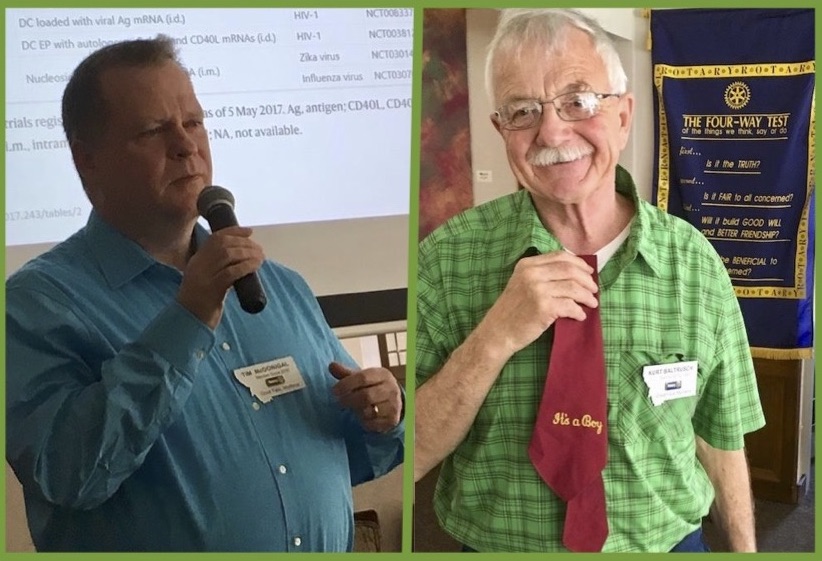
Tim McGonigal announced that he has finally achieved a long-time goal: creating a podcast. His is called McGonigal's Chronicles: Making Montana Connections, and it's available on iTunes, Spotify, and Stitcher. His focus is on interviewing interesting people who connect with Montana in some way. His first interview is with Dava Newman, a Helena native who went on to become a NASA Deputy Administrator and is now embarking on a new career as a professor at MIT. Tune in ... you'll enjoy it!
With the pre-announcement of his birthday, Kurt Baltrusch knew he was not going to get a free pass at Rotary, so he rolled with the occasion. Art Taft led us in the short version of the birthday song and, in his happy moment, Kurt displayed the tie his father had worn 72 years earlier on the day he was born. So cool.
Milestones
Just one birthday this week, that of the intrepid Tony DiLello on Monday. He shares a birthday with the likes of Saoirse Ronan, David Letterman, Tom Clancy, Henry Clay, and Beverly Cleary and although he has not yet become a famous writer, actor, late night show host, or statesman, we love him all the same. Many happy returns, Tony.